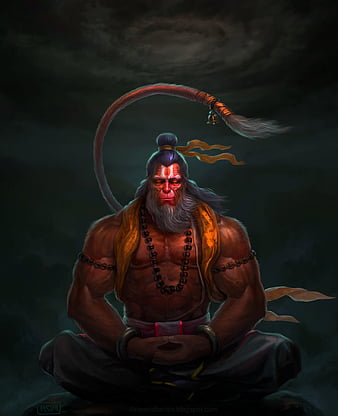
The Legend of Hanuman: A Tale of Bravery and Devotion


Long ago, in the land of ancient India, there lived a powerful warrior known as Hanuman. He was born to the Vanara tribe, a group of half-human, half-monkey beings, and possessed incredible strength, agility, and intelligence.

As a young boy, Hanuman was mischievous and playful, but he also had a deep sense of loyalty and devotion. He quickly became a disciple of Lord Rama, a powerful deity and the embodiment of righteousness and justice.

Hanuman's devotion to Lord Rama was unwavering, and he became a key player in the epic battle between good and evil. His bravery and cunning helped Lord Rama and his allies defeat the demon king Ravana and restore peace to the land.

But Hanuman's legend didn't end there. He continued to be a loyal companion to Lord Rama, serving as his messenger and confidante. He also became a symbol of strength, courage, and devotion to millions of people across India and beyond.

In many stories and traditions, Hanuman is said to possess magical powers, including the ability to change his size and shape, fly through the air, and even lift entire mountains. He is also known for his deep wisdom and spiritual insight and is often invoked as a source of guidance and protection.

Today, the legend of Hanuman lives on, inspiring people around the world to be brave, compassionate, and devoted to their beliefs. Whether in times of triumph or adversity, Hanuman's story reminds us of the power of faith and the potential for greatness that lies within us all.

Comments

Popular posts from this blog

Adi Shankaracharya: The Philosopher Who Changed India

Adi Shankaracharya is one of the most revered figures in the history of India, known for his profound wisdom and his contributions to the development of Hindu philosophy. His life and teachings continue to inspire and influence people around the world to this day. Born in the 8th century CE, Adi Shankaracharya was a scholar and philosopher who traveled extensively throughout India, studying the Vedas and other ancient texts and engaging in debates with other scholars. He was a prolific writer, and his works on Advaita Vedanta are still widely read and studied today. One of his most famous teachings is the concept of non-dualism, which holds that there is only one ultimate reality and that all apparent distinctions between the self and the world are ultimately illusory. This idea has had a profound impact on Indian philosophy and spirituality and has influenced thinkers in many other fields as well. Adi Shankaracharya also established four monasteries in different parts of India, which...

The Eternal Power of Vishnu: Understanding the Cosmos Through Vishnu Purana First Amsa

  Vishnu Purana is one of the eighteen Puranas in Hindu literature, which deals with a range of topics, including cosmology, mythology, and genealogy. The first Amsha or part of Vishnu Purana presents a unique perspective on the creation, maintenance, and destruction of the universe. Unlike some other Puranas where Shiva or Brahma or goddess Shakti are offered prominence, the central element of the cosmology presented in Vishnu Purana is the Hindu god Vishnu. The first part of Vishnu Purana describes the reverence and worship of Vishnu in 22 chapters as the means for liberation. The first five chapters of Vishnu Purana present the mythology of creation, which is woven with the evolutionary theories of the Samkhya school of Hindu philosophy. Vishnu is described as the source of all elements, all matter in the world, the entire universe, all living beings, as well as Atman (Inner Self, essence) within every living being. One of the most famous legends in the Vishnu Purana is the stor...

Attaining the power of supreme

 Chapter 8 of the Bhagavad Gita is titled "Attaining the Supreme" and focuses on the path to ultimate liberation and enlightenment. In this chapter, Lord Krishna explains to Arjuna the nature of the afterlife and how to attain a state of union with the divine. The chapter begins with Lord Krishna describing the ultimate reality of Brahman, the source of all beings. He explains that by meditating on Brahman at the time of death, one can attain a state of transcendence and achieve liberation from the cycle of birth and death. Lord Krishna explains that the nature of the afterlife depends on one's state of consciousness at the time of death. Those who are attached to the material world and have not attained a higher level of consciousness will be reborn into the material world, while those who have attained a higher level of consciousness will merge with Brahman. Throughout the chapter, Lord Krishna emphasizes the importance of devotion and spiritual practice in attainin...